Sunscreen for men: how to read the label
Short answerThe label terms that matter are broad spectrum, SPF (sun protection factor) 30 or higher, and water resistant with a stated time. Words like waterproof, sweatproof and sunblock are not allowed on US sunscreens.
The full answer
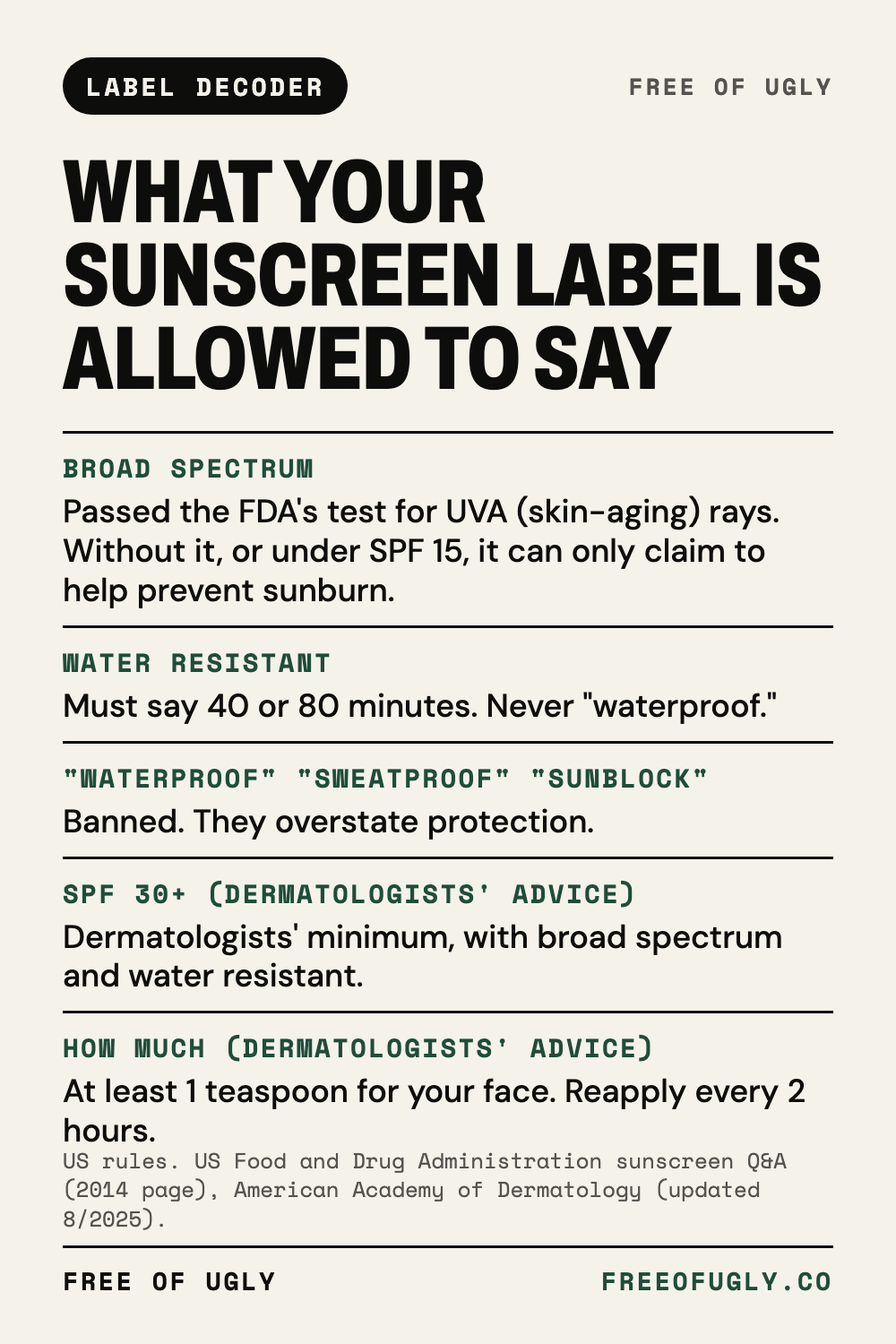
- Broad Spectrum: the US Food and Drug Administration (FDA) says passing the broad spectrum test shows the product provides UVA (skin-aging rays) protection proportional to its UVB (sunburn rays) protection. Sunscreens that are not broad spectrum, and broad spectrum ones with SPF 2 to 14, can only claim to help prevent sunburn.
- Water resistant: the label must say whether the product stays effective for 40 minutes or 80 minutes while swimming or sweating. Sunscreens that are not water resistant must carry a direction to use a water resistant one if swimming or sweating.
- Banned claims: sunscreens cannot be labelled "waterproof" or "sweatproof", or identified as "sunblocks", because those claims overstate effectiveness. They also cannot claim more than 2 hours of protection without reapplication, or immediate protection, without submitting data and getting FDA approval.
- SPF 30 or higher: this is what dermatologists recommend, together with broad spectrum and water resistant.
- How much: the American Academy of Dermatology (dermatologists' professional body) says at least 1 teaspoon for your face, and about 1 ounce (a shot glass) for the rest of exposed skin for most adults. Reapply every two hours, and right after swimming or sweating.
What this does not tell you
- The FDA page we read is the Q&A on the 2011 final rule. It carries a content-current date of 10/22/2014. We did not find a newer FDA page replacing these label terms.
- In December 2025 the FDA proposed adding a new sunscreen ingredient, bemotrizinol, to the over-the-counter drug monograph (the FDA's rulebook for allowed sunscreen ingredients). That is about an ingredient, not these label terms. We could not confirm from our search whether a final order has been issued, so check the FDA's over-the-counter monograph portal for the current status.
- A label tells you what a product is allowed to claim, not how it feels or how well you will wear it.
Sources
- US Food and Drug Administration: Questions and Answers, FDA announces new requirements for over-the-counter sunscreen products marketed in the U.S.Original announcement June 14, 2011; page content current as of 10/22/2014. Accessed 2026-10-23.
- American Academy of Dermatology: How to apply sunscreenLast updated 8/15/25. Accessed 2026-10-23.
- Covington: FDA proposes amendment to over-the-counter sunscreen monograph (Dec 2025)Law-firm summary of the December 2025 proposed order for bemotrizinol; secondary source. Accessed 2026-10-23.
Information, not medical advice. If something here applies to you, ask a doctor or dermatologist.
Free of Ugly: science over grift. If it works we say why. If it does not we say that too.