Skincare routine for men, graded by the evidence
How the grades work
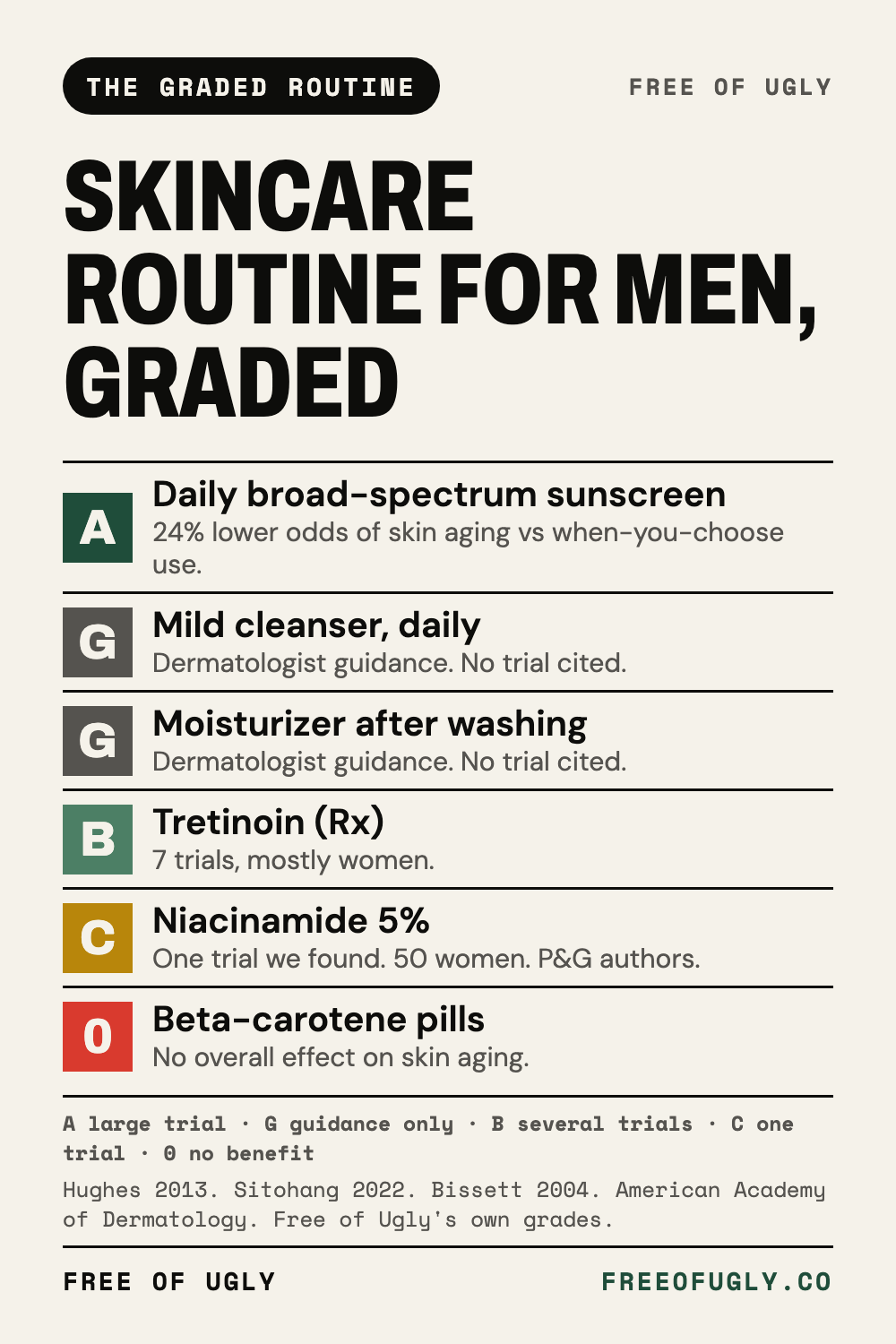
These grades are Free of Ugly's own judgment of the sources below, not an official scale. A means a large randomised trial (900+ adults here) that is also backed by guidance from the American Academy of Dermatology (dermatologists' professional body); only sunscreen qualifies. G means dermatologist guidance with no trial cited. B means several consistent randomised trials. C means one trial. 0 means a trial that found no overall benefit. These are not the letter grades used by the US Preventive Services Task Force (an independent panel of medical experts). This is an evidence ladder, not a morning-and-night order: it mixes prevention (sunscreen), treatment (tretinoin) and appearance (niacinamide).
Step by step
- Daily broad-spectrum sunscreen (A). Dermatologists advise a broad-spectrum, water-resistant sunscreen with SPF 30 or higher, at least 1 teaspoon for the face, reapplied every two hours outdoors. In the Nambour trial, 903 adults under 55 were randomised to daily broad-spectrum sunscreen or to using it when they chose to, and the daily group showed no detectable increase in skin aging over 4.5 years. Skin aging was 24% less than in the discretionary group (relative odds 0.76, 95% confidence interval 0.59 to 0.98, so the benefit could be small; the abstract lists the trial's power to detect moderate effects as "modest"). The abstract does not state an SPF number.
- Mild cleanser (G, guidance). Dermatologists advise washing your face daily and after exercise with a mild cleanser and lukewarm water, and fragrance-free or non-comedogenic products depending on your skin.
- Moisturizer (G, guidance). Dermatologists advise moisturizing daily, right after bathing or shaving, while the skin is damp.
- Prescription tretinoin (B). Ask a dermatologist about it. A 2022 systematic review of 7 randomised trials found topical tretinoin consistently improved wrinkling, mottled pigmentation, sallowness and age spots from as early as 1 month. Four trials included only women and the rest were mostly women, and formulas and outcomes varied.
- Niacinamide 5% (C). A 2004 12-week, double-blind, split-face trial of 50 women aged 40 to 60 found improvements in fine lines, spots, redness and sallowness. The authors are Procter & Gamble employees. A 2005 paper from the same group reports a similar design and may overlap; we count it as one body of evidence.
- Beta-carotene pills (0). In the same Nambour trial, beta-carotene supplements had no overall effect on skin aging, though the authors saw contrasting associations in subgroups and say further study is needed. Separately, the task force recommends against beta-carotene supplements for preventing heart disease or cancer.
What this does not tell you
- The Nambour trial was run in Queensland, Australia (latitude 26 degrees south), and had some missing outcome data (the authors note it). Results may differ in a cloudier climate.
- We did not grade other products people ask about, such as toners, charcoal washes or red-light devices. Absence from this list is not a verdict.
- The dermatologists' men's skin care page did not mention retinoids, and its reviewed date is not shown. Retinoids are listed here from the trial review, not dermatologist guidance.
Sources
- Hughes et al. 2013, Sunscreen and prevention of skin aging: a randomized trial. Ann Intern Med 158:781-90903 adults; daily sunscreen 24% less aging; beta-carotene no overall effect. Accessed 2026-10-23.
- Sitohang et al. 2022, Topical tretinoin for treating photoaging: a systematic review of randomized controlled trials. Int J Womens Dermatol7 randomised controlled trials; women majority. Accessed 2026-10-23.
- Bissett, Miyamoto, Sun, Li, Berge 2004, Topical niacinamide reduces yellowing, wrinkling, red blotchiness, and hyperpigmented spots in aging facial skin. Int J Cosmet Sci 26:231-850 women aged 40 to 60, 12 weeks, split-face, 5% niacinamide; authors at P&G. Accessed 2026-10-23.
- American Academy of Dermatology: Skin care tips for menWashing, moisturizing and sunscreen advice. No date shown on the page. Accessed 2026-10-23.
- American Academy of Dermatology: How to apply sunscreenPage last updated 8/15/25. Accessed 2026-10-23.
- US Preventive Services Task Force: Vitamin, mineral and multivitamin supplementation (June 2022)D grade (recommended against) for beta carotene for cardiovascular disease and cancer prevention. Accessed 2026-10-23.
Information, not medical advice. If something here applies to you, ask a doctor or dermatologist.
Free of Ugly: science over grift. If it works we say why. If it does not we say that too.