Hydrocortisone on your face: what the label and the reports say
The full answer
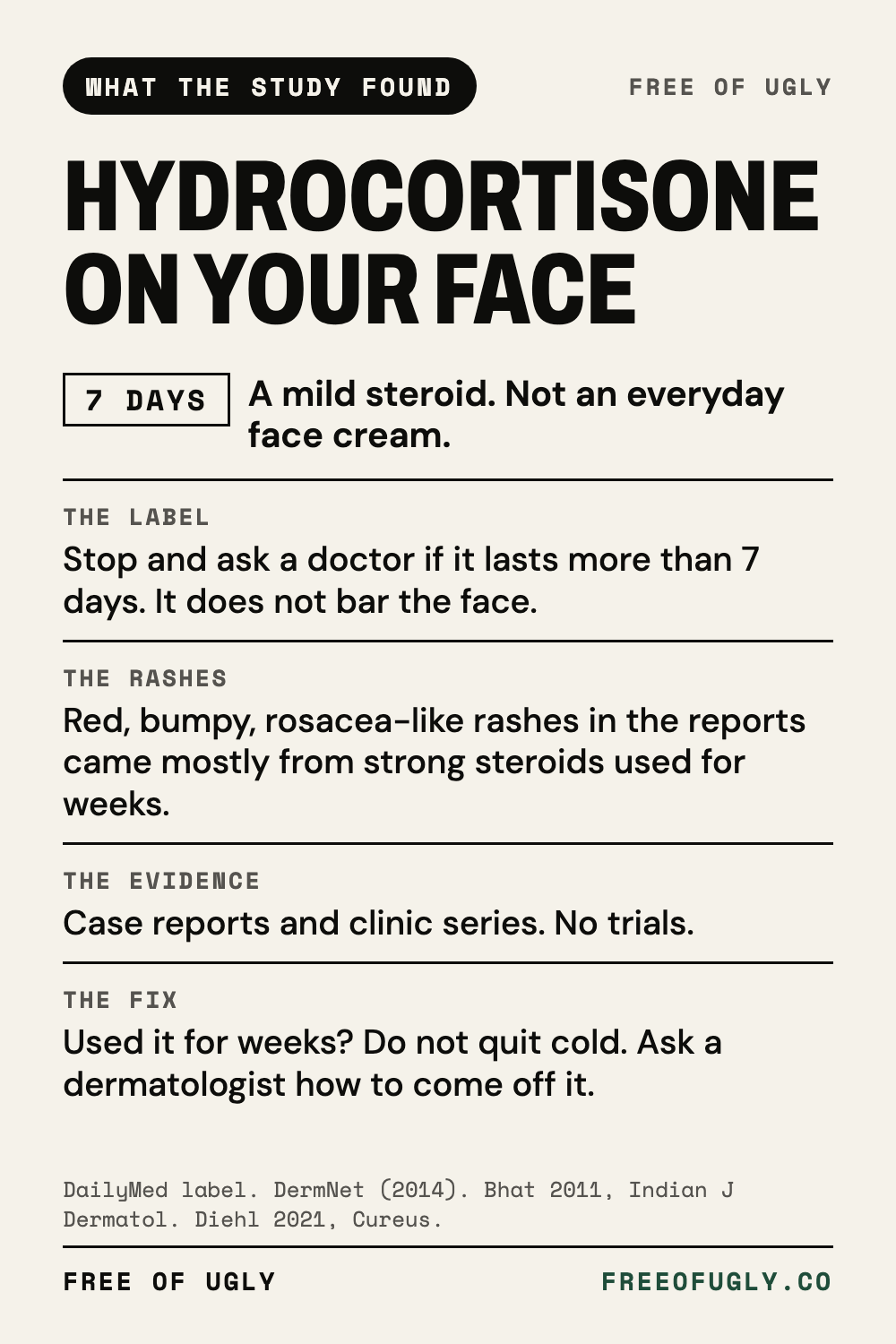
The label on a US hydrocortisone 1% cream (ProStat First Aid, on DailyMed) lists use for temporary relief of itching from minor skin irritations and rashes, including seborrheic dermatitis. It says not to use it in the eyes or for diaper rash, and to stop use and ask a doctor if the condition worsens or lasts more than 7 days. It also says not to continue any hydrocortisone product for longer than 7 days. It does not bar use on the face.
DermNet, reviewed by dermatologist Dr Amanda Oakley (page dated June 2014), describes steroid rosacea as a rosacea-like condition on the mid-face caused by potent topical steroids or their withdrawal. Redness, bumps and pustules appear after several weeks of applying a steroid to the forehead, eyelids, cheeks or chin. It is more likely and more severe with strong steroids, and less likely with mild steroids, particularly when applied infrequently. It can flare badly when the cream is stopped, and DermNet recommends slow withdrawal.
A 2011 series of 200 patients (Bhat and colleagues) with more than a month of topical steroid use on the face found the majority were using potent (class II) steroids for trivial facial skin problems. A 2021 case report (Diehl and Cohen, Cureus) describes one man who developed a perioral and rosacea-like rash after using a high-potency steroid twice daily on the face.
So the evidence ties the problem to strong steroids and to weeks of use. We did not find a trial testing 1% hydrocortisone on the face over weeks, so we cannot say how often it happens with the drugstore strength.
What this does not tell you
- All of the rash evidence here is case reports and clinic series. None is a controlled trial.
- The case report and the series involve strong steroids, not hydrocortisone 1%.
- The DermNet page is dated 2014.
- Not every perioral rash is caused by steroids; some occur with no steroid use.
- Information, not medical advice. If you have a face rash that keeps coming back, see a dermatologist before you stop or restart any steroid.
Sources
- DailyMed, Hydrocortisone Cream USP 1%, ProStat First Aid LLC (SPL f707bda4-074a-6406-e053-6394a90a7ae1), Drug Facts labelLabel wording varies by maker. Stop and ask a doctor if symptoms persist more than 7 days; does not bar the face. Accessed 2026-11-02.
- DermNet, Steroid rosacea (reviewed and updated by Dr Amanda Oakley, dermatologist, June 2014)Clinical reference page, not a trial. Mild steroids less likely to cause it; slow withdrawal recommended. Accessed 2026-11-02.
- Bhat YJ, Manzoor S, Qayoom S. Steroid-induced rosacea: a clinical study of 200 patients. Indian J Dermatol. 2011;56(1):30-2 (PMID 21572787, PMC3088930)Series of 200 patients with over 1 month of facial topical steroid use; majority used potent (class II) steroids. Clinic series, not a trial. Accessed 2026-11-02.
- Diehl KL, Cohen PR 2021, Topical Steroid-Induced Perioral Dermatitis (TOP STRIPED): Case Report of a Man Who Developed Topical Steroid-Induced Rosacea-Like Dermatitis (TOP SIDE RED). Cureus (PMID 33996307)Single case report; high-potency steroid twice daily on the face, not hydrocortisone 1%. Accessed 2026-11-02.
Information, not medical advice. If something here applies to you, ask a doctor or dermatologist.
Free of Ugly: science over grift. If it works we say why. If it does not we say that too.