Does creatine cause hair loss? What the studies actually found
The full answer
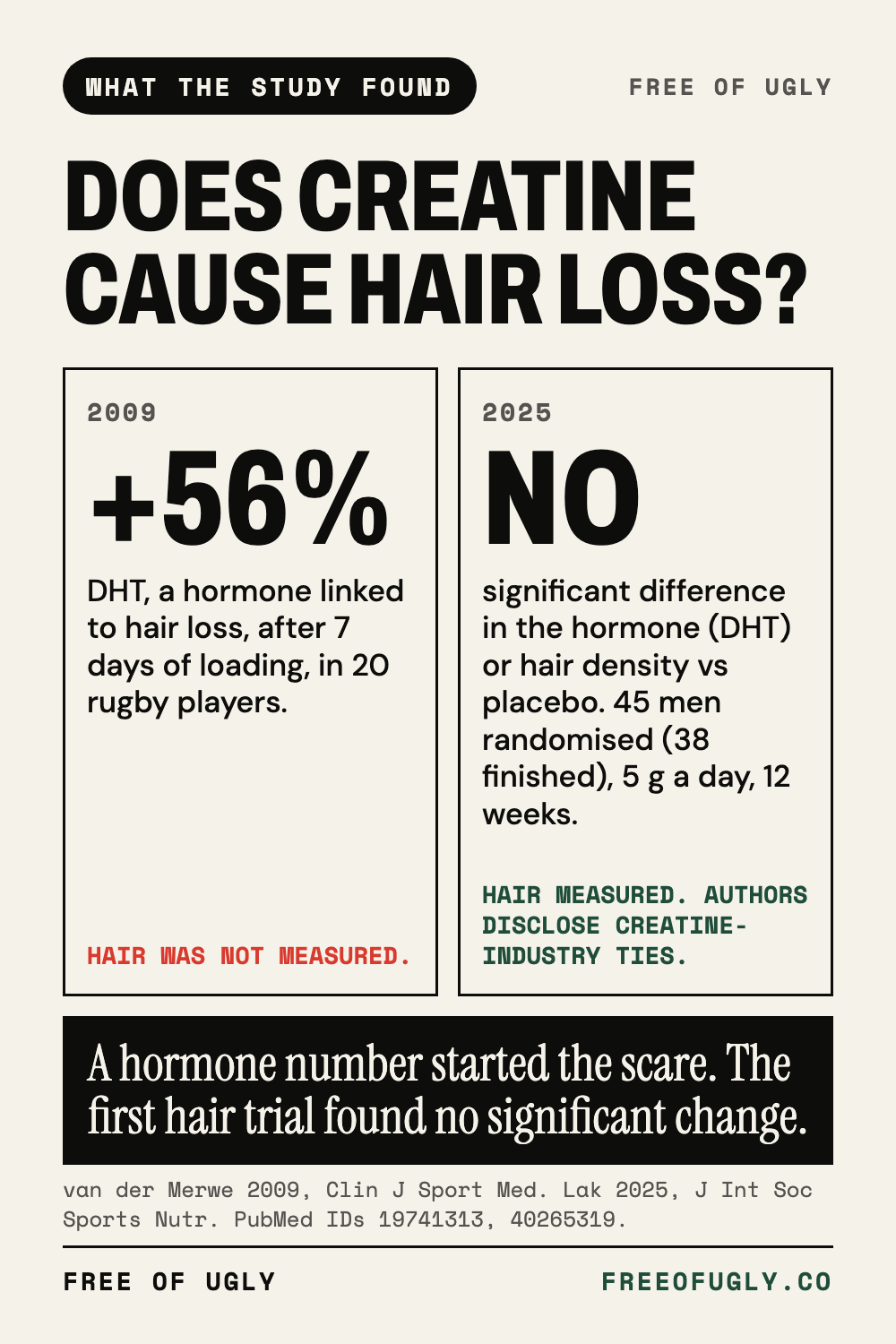
The 2009 study (van der Merwe, Brooks and Myburgh) was a double-blind, placebo-controlled crossover in 20 college-aged rugby players. After 7 days of creatine loading (25 g a day), serum DHT (dihydrotestosterone, a hormone linked to pattern hair loss) was 56% higher, and 40% above baseline after 14 days at 5 g a day. The DHT-to-testosterone ratio rose 36% and then 22%. Testosterone did not change. DHT is the androgen implicated in pattern hair loss in people who are genetically prone to it. The study did not measure hair, and its authors called for further investigation.
The 2025 trial (Lak and colleagues, Journal of the International Society of Sports Nutrition) is the one that measured hair. 45 resistance-trained men aged 18 to 40 were randomised to 5 g a day of creatine monohydrate or placebo for 12 weeks; 38 finished. Hormones were measured at baseline and 12 weeks, and hair was assessed with a trichogram and a FotoFinder system (hair density, follicular unit count, hair thickness). There were no group-by-time differences for any hormone, including DHT and the DHT-to-testosterone ratio, or for any hair measure. The authors describe it as the first study to directly assess hair follicle health after creatine supplementation.
So: a 2009 study (20 players, 3 weeks) found a DHT rise and did not look at hair. A 2025 trial (45 randomised, 12 weeks, no loading phase) measured hormones and hair and found no significant difference from placebo. The designs differ, so they are not a like-for-like contradiction. That does not prove creatine can never affect any one person's hair, but we found no direct evidence for the claim.
What this does not tell you
- The 2025 trial ran 12 weeks in 38 completers. It cannot speak to years of use.
- Several of the 2025 authors disclose ties to creatine and supplement companies (including Creapure, the monohydrate maker). The conflict-of-interest statement is in the PubMed record.
- Participants in the 2025 trial were healthy young males, not men selected for hair loss, and 12 weeks is short. The 2009 abstract states no funding.
- The 2009 study used a loading phase (25 g a day) and then 5 g a day; DHT stayed 40% above baseline at 5 g.
- If you are noticing hair loss, see a dermatologist rather than guessing at a cause.
Sources
- van der Merwe, Brooks, Myburgh 2009, Three weeks of creatine monohydrate supplementation affects dihydrotestosterone to testosterone ratio in college-aged rugby players. Clin J Sport Med 19(5):399-404n = 20, double-blind placebo-controlled crossover; DHT +56% at 7 days; hair not measured. Accessed 2026-10-23.
- Lak et al. 2025, Does creatine cause hair loss? A 12-week randomized controlled trial. J Int Soc Sports Nutr 22(sup1):2495229n = 45 randomised, 38 completed; no differences in DHT, DHT:T or hair measures. Conflict-of-interest statement included. Accessed 2026-10-23.
Information, not medical advice. If something here applies to you, ask a doctor or dermatologist.
Free of Ugly: science over grift. If it works we say why. If it does not we say that too.